
 European equipment leasing and vendor programmes in 2026 are growing in volume but are shaped by high rates, weak core EU economies, tighter regulation, and stronger demand for flexible, Green- and “as-a-service” structures.[investec +1]
Market growth and macro backdrop
• Europe’s financial leasing services market is projected to grow at about 10.5% CAGR from 2025 to 2033, driven by transportation, construction, manufacturing, IT and healthcare demand.[cognitivemarketresearch]
• Leaseurope’s latest biannual survey for 2025 reports that new business volumes in Europe remain positive but with slower growth, reflecting economic stagnation in France and Germany and generally sluggish EU GDP.[liquiditas +1]
• Elevated borrowing costs and risk‑averse credit appetite from banks continue into 2026, especially for SMEs, making vendor leasing and non‑bank funders more central to capital investment.[investec +1]
Structural trends in equipment leasing
• Operating leases and usage‑based models are gaining share, as customers avoid long economic ownership in sectors with rapid tech change and uncertain output pricing.[linkedin +1]
• Key growth verticals include renewable energy, construction machinery, transport, and medical equipment; healthcare leasing is supported by VAT and depreciation incentives plus a need to keep tech current.[cognitivemarketresearch +1]
• Pan‑European rental players are scaling, with the European equipment rental market around 37 billion USD in 2024 and forecast CAGRs just above 5%, underpinning larger, more structured vendor and rental programmes.[investec]
Vendor finance and supply‑chain programmes
• Across Europe, supply‑chain and vendor finance programmes expanded through 2025, increasingly reaching mid‑market suppliers rather than only large multinationals.[gfmag +1]
• Programmes increasingly link pricing to ESG metrics, with structures where suppliers obtain better discount margins when sustainability ratings improve, as seen in leading supply‑chain finance platforms.[gfmag]
• Manufacturers with integrated vendor leasing frameworks are using finance as a sales accelerator to overcome capex blocks, shorten deal cycles, and retain control of residuals across 30+ European countries via multi‑funder panels.[investec]
Funding landscape and regulation
• Banks remain key providers but are constrained by Basel IV / CRD VI capital rules, pushing them toward risk transfer, rated structures and partnerships with private credit and institutional investors.[reedsmith]
• Non‑bank and specialised leasing companies are gaining share, especially in NAV‑style and asset‑backed structures, with expectations that these markets could roughly double over the next 2–3 years.[reedsmith]
• Upcoming EU cross‑border lending and licensing rules will tighten oversight of non‑EU lenders and non‑bank players, making local regulatory compliance and in‑country documentation more important in any pan‑European vendor programme.[reedsmith +1]
Implications for 2026 vendor programmes
Equipment Leasing trends for 2026
Key Strategic Implications for Vendors.
Vendors should prioritise Southern European expansion to capitalise on the growth in those markets.
Key Strategic Implications for Vendors.
Vendors should prioritise Southern European expansion to capitalise on the growth in those markets.
Tariffs, Inflation, and Capex: Cross-border uncertainties, tariffs, and inflation persistently impede capital expenditure (capex) cycles in established European Union (EU) economies. Consequently, customers increasingly opt for leasing as a risk mitigation strategy and a means of managing cash flow. Countries adept at adapting to these challenges—by expanding vendor leasing initiatives—secure market advantages.
In 2025, European businesses continue to face significant challenges in securing lease financing, as economic and regulatory pressures persist. This updated report highlights key factors influencing the equipment leasing landscape, with a particular focus on tariffs, economic stagnation in France and Germany, and the strategies businesses can adopt to adapt and thrive.
The State of European Equipment Leasing in 202Main Take Aways.
The limited availability of Capex for equipment remains a critical issue for many businesses across Europe, affecting sectors such as manufacturing, retail, and even the traditionally resilient Mittelstand in Germany. CFOs are navigating an increasingly complex environment of rising costs, stagnating revenues, and uncertain investment climates.
The EU forecasts continued sluggish growth in France and Germany—the two largest economies in Europe—due to structural challenges, reduced domestic consumption, and external economic pressures. France faces an extended period of economic slowdown, while Germany’s industrial backbone struggles with stagnation. Both countries, along with others in the DACH region, are contending with the ripple effects of potential tariffs, adding further strain to an already fragile business environment.
We have tried to indicate what businesses in Europe are experiencing, this insight into European equipment leasing 2024 reveals some of the hidden factors that often go under the radar
The lack of Capex for all equipment in Europe has been a notable and growing concern impacting most  manufacturing and retail sectors including the previous resilient Mittelstand in Germany.
CFO’s across Europe are all balancing costs, and future projects and expenditure, often against falling revenues.
In France, the EU has stated that this year, they will have subdued investment set to weigh on growth, and they went further on Germany, stagnation, followed by a sluggish recovery. They are not alone, most of the Dachs region and the rest of Europe is in a similar situation.
So what is going on?
Economic Uncertainty
1.Global Economic Slowdown: Uncertainty in the global economy, exacerbated by geopolitical tensions, trade conflicts, and varying recovery rates from economic downturns, has made European companies more cautious in their spending. Exports are down in many countries that looked towards China for continued and future growth.
2.Inflation and Interest Rates: Higher inflation rates and increased interest rates raised the cost of borrowing, thereby discouraging investment in new equipment. As an observation, rates go up quickly, but come down slowly!
3. Supply Chain Disruptions. The pandemic disrupted global supply chains, leading to delays and higher costs for equipment and raw materials, with some countries now starting to stockpile various commodities, to try to ensure their future economic stability.
4. Geopolitical Instabilities. I never thought that in our lifetime, we would give this a cause of uncertainty concerning leasing! But times have changed. This has led to a lack of confidence, uncertainty in the future.
Regulatory and Environmental Pressures
1.Environmental Regulations: Stricter environmental regulations in Europe have pushed companies to invest more in sustainable technologies, which can be costlier and require longer-term planning and commitments. The desire to go “green” is strong, but most countries simply lack the infrastructure.
2.Technological Transition: The shift towards digitalization and green technologies requires substantial upfront investment, which some companies may find difficult to justify without clear short-term returns. Changes in equipment are no longer considered every two or three years event. Radical changes or updates now often occur in weeks or months, meaning possible obsolescence within a year! Not ideal for a serious investment.
Sector-Specific Issues
1. Industrial Sector: Traditional manufacturing and industrial sectors, which are significant in Europe, face a higher barrier to modernisation due to the cost of adopting new technologies like automation and robotics.
2. Service Sector: The service sector across Europe, particularly SMEs, often has limited access to capital, making it difficult to invest in high-cost equipment.
Investment Climate, the Perfect Storm
1.Risk Aversion: Investors, banks and finance companies are becoming more risk-averse, preferring to hold onto cash reserves, to help them comply with Basel 111 regulations.
2.Venture Capital: A shift in venture capital trends towards AI software and digital solutions. Heavy equipment and manufacturing industries are not the flavours of the year.
So consider all the above, this is what your sales team is facing.Manufacturers selling into Europe in 2026 need embedded leasing in their sales process to neutralise capex freezes, shifting discussion from €80k+ ticket prices to daily or quarterly rentals with mid‑term upgrade paths
How can Oak help your sales team?
Sales are based on features, advantages, and benefits. By minimising the amount required that a customer has to consider, not say €84K, but a quarterly rental of €4,762, just under €53 per day you are minimising the cost objection over the advantages and benefits of your equipment. The larger the equipment cost, the better the monthly rental will appear.
For £84k, your customer will automatically ask the question, what is the best discount you can offer, but if the cost is presented as a rental, there is less of a pushback from the customer.
The customer can upgrade his equipment to the latest at any time during the rental period, overcoming obsolescence.
Why use Oak?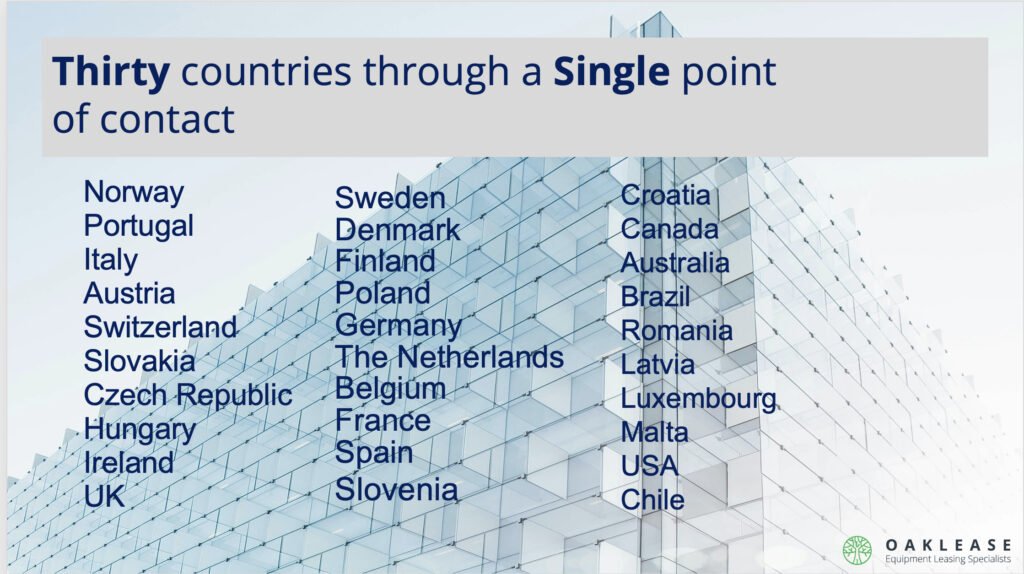
1.With access to over forty European funders, we have the robust financial capacity to fund your customer’s requirements.
2. Oak covers thirty European countries, local documentation and support.
3. Established for over thirty years
You will not win every opportunity that may come your way, but by using Oak, you will close more sales, and at a better margin.
Look what our suppliers say,
As a leading worldwide precision CNC manufacturer, ANCA provides our customers with crucial production elements with our machines and technology. Our customers require quick and flexible decisions to optimise their capacity. Oak is a crucial ANCA partner to this end. Their professionalism and excellent funding network make them an ideal finance partner for efficient and effective financing throughout Europe.”
Martin Winterstein, Managing Director, ANCA Europe GmbH
We are available on Teams, Zoom, FaceTime and Meet, why not give us a call just like Martin did, he knew where it would lead!
Check these case studies below

2026 marks a decisive turning point for equipment leasing across Europe. After several years of economic uncertainty, investment confidence is returning, and suppliers are once again looking outward for growth. The strongest trend is unmistakable: manufacturers can no longer rely on isolated, country‑specific finance arrangements. Growth now depends on a unified, pan‑European vendor leasing programme.
Why Pan‑European Leasing Now Matters
European buyers increasingly expect consistency—consistent pricing, documentation, service levels, and approval processes. A fragmented approach creates friction, slows sales cycles, and weakens competitiveness. In contrast, a coordinated European programme:
- Removes barriers to cross‑border sales
- Provides predictable, transparent finance options
- Strengthens vendor credibility in every market
- Increases conversion rates by reducing upfront cost pressure
Market Dynamics in 2026
- Cross‑border trade is accelerating, especially in Northern and Central Europe.
- SMEs are prioritising cash flow, making leasing the preferred acquisition method.
- Vendors with unified finance programmes are winning larger, multi‑country deals.
- Customers expect digital tools, instant illustrations, and clear explanations.
Oaklease’s Strategic Advantage
With over 33 years of deep European experience, Oaklease understands the regulatory, cultural, and credit differences across the continent. Our strength lies in turning these complexities into a single, coherent vendor programme that works seamlessly across borders.
The Growth Imperative
In 2026, the vendors who scale fastest will be those who remove friction from the buying process. A pan‑European leasing programme is no longer optional—it is the engine of sustainable growth.


